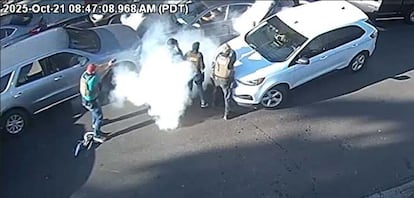
White smoke rises from the wheels of a Toyota Camry hemmed in by pickup trucks belonging to immigration officers who have chased the driver down a street in South Los Angeles. It seems the driver wants to flee, but there is no escape. One of the officers on the scene pulls out his pistol and fires. The man behind the wheel, an undocumented Mexican named Carlitos Ricardo Parias, but better known by his TikTok handle, “Richard LA,” who documents and reports on immigration raids, gets a bullet in his arm. Another bullet hits the hand of a sheriff’s office deputy. Parias is taken to hospital, accused of assaulting a federal officer, and will have to face immigration proceedings.
The incident occurred on October 21, but similar events have been occurring week after week over the past few months. In recent days, there have been at least two similar scenes, in Phoenix and again in Los Angeles. In Chicago, in mid-September, an almost identical sequence of events took place except that the suspect was not hemmed in by police vans. Instead, a Mexican man died, the first to do so from a police bullet during an Immigration and Customs Enforcement (ICE) operation this year. Since then, chases, clashes and shootings have become the norm amid the increasingly intense immigration crusade driven by U.S. President Donald Trump.
Apart from shootings, another controversial maneuver is the so-called PIT (Precision Immobilization Technique), which consists of driving a car at full speed into the precise position needed to arrest an alleged fugitive. It’s a dangerous technique, as it can send the car into a spin if done at high enough speed, but there’s already been evidence, especially through videos posted on social media by Chicago residents, that it’s being implemented. Likewise, crashes and traps, such as the one applied to Parias in Los Angeles, have also become common, according to online evidence.
Whistleblowers, pro-migrant activists and experts point out that arrests of suspected undocumented immigrants are low risk for officers. These are not criminals and they should not require this type of technique, much less the use of firearms. A PIT maneuver is considered a use of deadly force and is justifiable in certain situations, depending on the suspect’s risk to the public, the risk to the officer, and the potential collateral damage of a crash, according to Jerry Robinette, a former special agent in charge of ICE’s Homeland Security Investigations.
He told CNN. “There are a series of factors that agents have to take into account before they even become involved in a high-risk pursuit. When you’re involved in a high-risk pursuit, one of your main responsibilities is the general public, along with yourself and the violator.”
In response to criticism, government officials simply trot out the same line. They allege that attacks on ICE agents and other federal agencies have “increased 1,000 percent” from the previous year — a figure that has been disputed; this is the same argument used for the deployment of National Guard troops to Chicago and Portland. Likewise, ICE insists that the incidents are provoked, either by the person suspected of being undocumented, or by people outside the operation: “This isn’t just the criminal alien targets doing this, but also bystanders who are obstructing and attacking us.”
The Department of Homeland Security (DHS), meanwhile, has defended the use of crash maneuvers when cornering supposedly undocumented migrants and has also removed all responsibility from the officers. “Anyone who intentionally rams law enforcement with their vehicle will be arrested and prosecuted to the fullest extent of the law — that’s a promise,” said Tricia McLaughlin, a spokeswoman for the agency.
However, the evidence — available only when witnesses record the incident or there is a video from security cameras — shows that the alleged aggressions against agents or their vehicles are not always exactly as described by the authorities. A few days before the incident in California in which Parias was shot and wounded, footage was taken in Chicago of a chase. A white Border Patrol pickup truck crashed into a red vehicle during an immigration operation. The impact sent the car careering backwards until it collided with another.
The DHS explained that the pursued vehicle was driven by a person who had first rammed the ICE officers, and that they responded with an authorized PIT maneuver. Although not conclusive evidence, the videos do not show the first alleged crash, only the one carried out by ICE.
In the September case that resulted in the death of Mexican Silverio Villegas-González, ICE alleged that the man had used his car to run over and drag an officer for several meters in order to justify their use of deadly force. Videos from citizens that circulated later, however, showed that Villegas-González did not run over the officer forcefully and at no time dragged him. And despite the fact that the DHS insisted the officer in question had been seriously injured, he was released from hospital the same day.
At the end of October, another operation in Phoenix ended with a Honduran immigrant injured. According to documents obtained by a local television station, an ICE officer shot José García-Sorto, the driver of a vehicle stopped on the I-17 freeway, twice. The DHS claimed that the man sped away but there was an officer in his path, who “feared for his life” and “defensively discharged his service weapon two times, striking García-Sorto’s vehicle.” García-Sorto was taken to hospital, as was the officer.
In this case, there is footage taken by bystanders to contrast the official version, and the FBI has taken over the investigation. In its statement, the DHS blamed “dishonest politicians” and “activists who urge illegal aliens to resist arrest” and stressed that “aggressions against federal officers, including hit-and-runs, have grown by more than 1,000%.”
For critics, the repetition of clashes and shootings demonstrates a hardening institutional stance. And the incidents pile up: unmarked pickup trucks blocking streets, crashes at intersections, gunshots. Meanwhile, footage recorded by bystanders or by those involved themselves circulates on social networks and is blamed by the DHS for fueling polarization around immigration policy.
Sign up for our weekly newsletter to get more English-language news coverage from EL PAÍS USA Edition